Showing posts with label house rules. Show all posts

Monday, September 19, 2016

House Rule: Preparing Spells


The new Sage Advice from Wizards of the Coast came out today, and they noted something about spell preparation I dislike.
Can spellcasters prepare spells not all at once, but prepare spells at various times in the day? You prepare your list of spells only at the end of a long rest. You can’t prepare some spells at the end of the rest and then prepare more later.
This seems needlessly strict, and I don't know that there's any good in game reason for it. Sure, for clerics you can say that their deity wants prayers at dawn, or midnight, but that seems awfully small minded for most gods, and doesn't make sense for wizards. So here's the house rule:
Can spellcasters prepare spells not all at once, but prepare spells at various times in the day? Yes. During the day, a spellcaster can use a short rest to prepare new spells in slots she has available.
That should provide some flexibility, while the hour rest requirement prevents it from being misused. In my experience in 3rd edition, it was rare you wanted to leave a slot open in any case, so I'm not too worried about abuse.

Thursday, August 11, 2016

Herbs and the Man

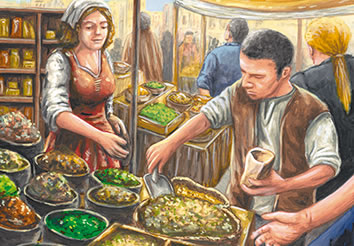
I don't like running a campaign where magic items are generally available for sale, especially in 5e. So when one of my players asked if potions of healing were available to be bought at the local temple. I told him that they were not, not unless the temple had a higher opinion of them than they do. I stand by this decision. It helps keep potions special, and gives them an incentive to help out the nice priests of Fayon. But some healing that didn't come from the cleric or paladin could be helpful. So, as I often do, I stole a page from Adventurer Conqueror King. The following herbs are available for sale at the local market for 10gp a dose. They may be used immediately after combat (or during combat), but only once per character. It requires a trained Healing or Survival check at DC 10 to gain the benefits of each herb.

Woundwort: After the First Demon War, the elves brought gifts to men to atone for their crimes. Among their gifts was woundwort, a balm for the injured. To this day, images of the plant are often used when elves and men undertake ventures jointly. When crushed and applied to a wound, it reduces swelling and quickens healing. Once per combat, an application of woundwort will heal 1d4 hit points.

Yellowroot: When Alexander was hunting the great wyrm Scatha, he of the
poisonous bite, a nymph maiden showed him this plant, which grew only in the deepest parts of the great swamp Gwaithe. Upon returning to Lyonia, he planted the seeds widely, and it can now be found across Arden Est. Once per combat, an application of Yellowroot will cure 1d6 hit points of poison damage. If given as a tea to an individual making saves against a poison, it will give them advantage on those saves.

Sunday, September 7, 2014

Lost Mine of Phandelver

After a hiatus, where I was playing a ruinguard in an evil party campaign, it looks like I'm back DMing again. We'd like to try out 5e, so I'm running the group through the adventure included in the Starter Set, Lost Mine of Phandelver. There are several things, though, that I like about ACKS, so I want to include some house rules. Please let me know if you have any comments.

Henchmen
Each player may hire henchmen if they so desire. Availability will depend on the DM, but there will be some available to start, and some may be encountered throughout the adventure, e.g., as prisoners. Each character has a maximum number of henchmen depending on her charisma:
3-4        1
5-7        2
8-12      3
13-15    4
16-18    5
Henchmen receive a half share of experience and a 15% share of gold. After each adventure, and when the henchman gains a level, the player must make a Charisma save. If the character was especially kind (extra share of the loot, magic item), the save is made with advantage. If the henchman suffered a calamity, the save is made with disadvantage.

Death Saves
There are no death saves. Instead, upon hitting zero hit points or lower, roll a d6 and consult the Death or Dismemberment table to see where you where hit. Once your friends come to turn the body over, roll d20 to see just how bad it was. The Tampering with Mortality table may make an appearance, but is unlikely to be necessary at low levels.

Thursday, December 12, 2013

XP Bonus for Session Summaries

I've enjoyed writing up the session summaries each week, but I don't always include all the details that might be interesting to people. Mostly because I forget. So to get different perspectives, I'm encouraging my players to write summaries by offering an xp bonus based on their level. It needs to be posted in a public place, either on this blog or elsewhere on the internet, reasonably detailed, and before the next session. The awards are roughly based on 5% of the xp the fighter needs for the next level, and are as follows:

1   100
2   200
3   400
4   800
5   1500
6   3000
7   6000
8   12000
9   20000
10 25000
11 30000
12 35000
13 40000

Saturday, September 7, 2013

House Rules on Proficiencies

I realized last Wednesday that I don't have a good grasp on what different proficiencies do, particularly those not likely to be taken by wizards. So I'm looking through the relevant chapter to see if I can't get some idea on how they work. As I was doing so, I came across the bribery proficiency, and decided to change it a little.

Bribery: As written, this proficiency allows the PC to offer bribes, with bonuses based on the size of the bribe. Since I want any PC to be able to offer a bribe, I need to amend this a little. Now, when offering a bribe, any character can gain a +1, +2, or +3 to the reaction roll for bribes equal to a day's wages, a week's wages, and a month's wages, respectively. But if you take the proficiency, you get double the bonus.